
Tom Stoppard
Remembering the master

A few years ago, I read Hermione Lee’s great biography of Tom Stoppard, who passed away last year at 88.
I read today in New York Magazine that 70-year-old Broadway director, the legendary (if you follow these things) Jack O’Brien, is acting in the new season of The Comeback, as Tommy Tomlin, hairdresser to fictional sitcom star Valerie Cherish in Lisa Kudrow’s cable series.
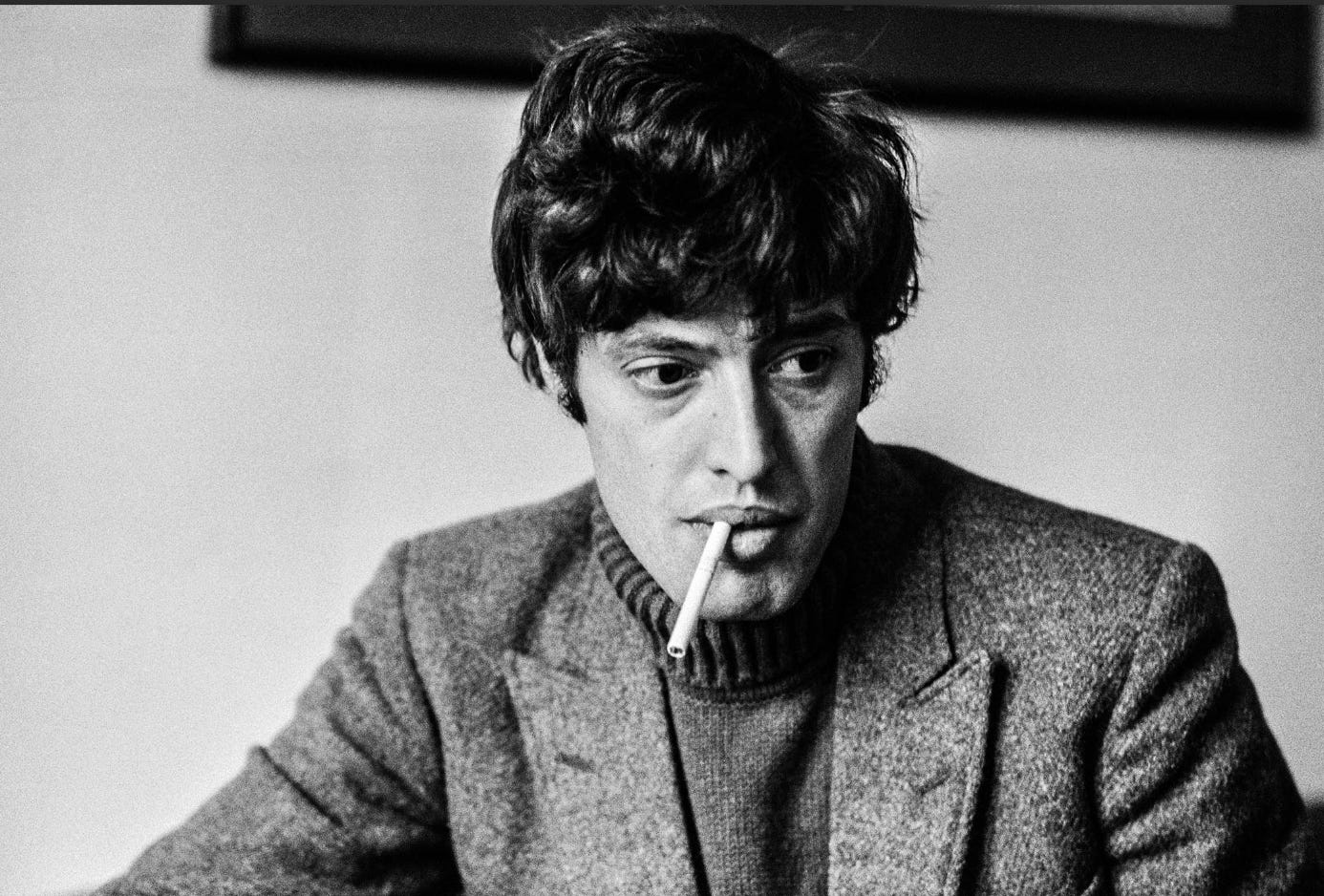
The magazine recalls that O’Brien was “the American entrusted with major productions of Stoppard plays such as The Invention of Love and The Coast of Utopia, a three-part epic for which O’Brien won his third Tony”.
As a great fan of the playwright, I was compelled to repost my In Memorium for Stoppard, originally published in Arts Fuse. Stoppard, whose plays were entertaining and often challenging, was a great British gentleman, what you might call a very ‘hip cat’, and one of the great playwrights of our age.
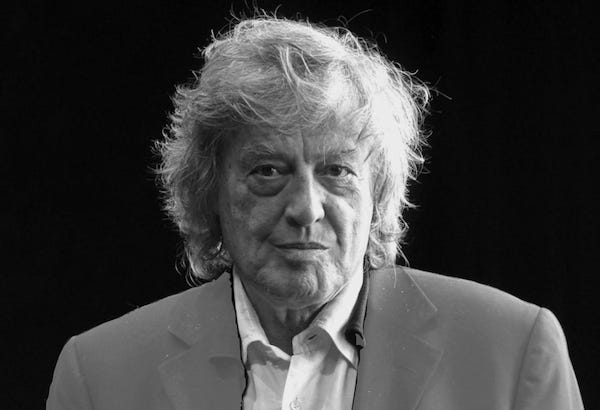
Sir Tom Stoppard died last Saturday at the age of 88. One of the great playwrights of the 20th century, his work reflected a distinctive talent — he wrote to entertain, but with intellectual rigor. Stoppard was erudite and wickedly observant, though rarely pompous. He could cleverly deflate his own self-worth. In 1976 he said, “The spiritual advantage is that success gives you an identity and it’s nice to be relieved of that search.” After reading about himself in a Who’s Who of 20th Century Literature, the dramatist said with hilarious false modesty: “I’m ‘currently fashionable’ but not that good intellectually. That is true. I know just enough to make a good impression in most conversations but I operate at my upper limit. The iceberg is all tip.”
Stoppard was glamorous and debonair, with a wild shock of unruly curly hair, but he was privately introspective. Family was a grounding force for him, but he maintained strong friendships with royalty, rock stars, and writers such as Harold Pinter and Václav Havel. Effortlessly sociable and buoyed by curiosity, he could converse with anyone on a vast range of subjects: science, mathematics, language, history, and love. He was morally serious but not overtly political. His goal was to be engaging while rendering philosophical ideas into theatrical form. It made him a valued guest at parties.
His breakthrough drama, Rosencrantz and Guildenstern Are Dead, was first produced at the Edinburgh Festival in 1966. Of its success, Stoppard quoted the character Mike Campbell from The Sun Also Rises: “We went broke two ways: suddenly and slowly.” Nevertheless, the play went on to win great acclaim and won him his first Tony Award for Best Play in 1968. It later became a film, which he directed in 1990, starring Tim Roth and Gary Oldman.
I first saw his work with The Real Inspector Hound on a double bill with After Magritte in New York in 1972. The former is a farce in which two critics, Moon & Birdboot, watch an Agatha Christie mystery, complete with stock characters, clever wordplay, and wonderfully awful clichés. Soon, the two pompous critics enter the drama themselves, as the line between art and life dissolves. It was Pirandello meets Monty Python. The opening one-act, After Magritte, attempted to apply narrative logic to surrealistic stage images drawn from Magritte’s paintings. I had never seen theater quite like this before, and after that, I was ready to see anything Stoppard wrote for the stage.
He did not like his writing to be overanalyzed or interpreted. Instead, Stoppard believed the language itself could do the work, even though his dialogue was often dense with references to philosophy, history, and science. The rapid-fire wordplay in Jumpers (1972) leaves you breathless. That production, which came to the Huntington Theatre Company in 1987, pairs language games with on-stage acrobats, one of Stoppard’s most breathtaking conceits. At its core, the script is a kind of philosophical treatise contained within a farcical whodunit. That play and others explore the threat of moral relativism in an apparently indifferent universe. Travesties (1974), produced at the Huntington in the mid-’90s, is a farce set in Vienna in 1917. There, the Dadaist Tristan Tzara, the novelist James Joyce, and the revolutionary Vladimir Lenin engage in a debate over their contradictory views on art and politics. This literary/political mashup won him his second Tony Award.
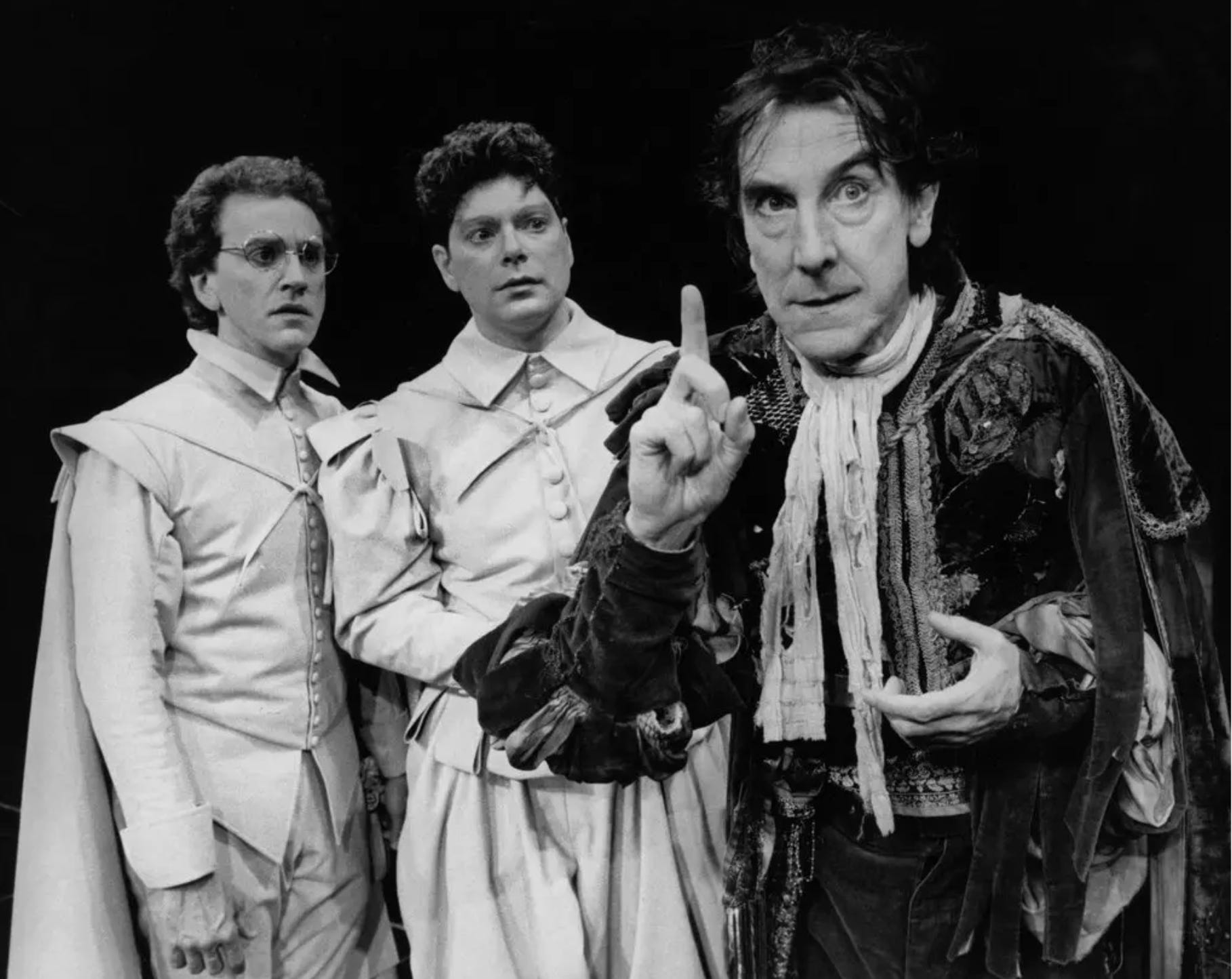
One of the best stage productions I’ve ever seen was the 1984 Broadway touring production of The Real Thing in Boston, which starred Jeremy Irons and Glenn Close. Directed by Mike Nichols, the evening was a revelation. Here, Stoppard went deeper and more fearlessly into his ideas about art and the nature of love. The playwright had found, as one critic said, “the courage to abandon ironic distance.” It won him another Tony for Best Play.
The Invention of Love (1997) was called “over-informative and repetitious” by some critics, while others were moved by its wit and emotional resonance. Even though I was unfamiliar with the subject, the life and work of classical scholar and poet A.E. Housman, the words tumbled out with such eloquence that — no matter how much I understood or could infer from the dialogue — I left the theater feeling smarter and a little more awake to the capacities of language.
Along with writing plays, Stoppard wrote screenplays. Among those were Terry Gilliam’s Brazil (1985), Steven Spielberg’s Empire of the Sun (1987), and Shakespeare in Love (1998), for which he won an Oscar for Best Original Screenplay. Nevertheless, he was once quoted as saying, “Film writing is junk food … advanced technique in the service of arrested development.”
There are many of Stoppard’s plays I have yet to see. I never got to Arcadia at Lincoln Center in 1993, nor the nine-hour, three-part The Coast of Utopia, an epic trilogy on Russian intellectual history that premiered in 2002. The latter consists of three plays: “Voyage,” “Shipwreck,” and “Salvage.” It was reported to have had over 40 actors and 70 characters. The ambitious project was awarded seven Tony Awards in 2007.
I finally made it to New York for a production of Stoppard’s Rock and Roll in 2007. That play spans decades, blending Czech politics, ideas on freedom of speech, the media, and the power of rock music. The story takes place between 1968 and late 1989, during the Velvet Revolution, which peacefully ended four decades of communist rule. Stoppard’s friend, the playwright Václav Havel, became president of the Czech Republic after the Russian withdrawal. At the time, I had just visited the Czech Republic, where Milan Kahout, who now resides in Boston, was living. Kahout was one of the revolutionary performance artists at the time who helped facilitate the change of regime and remains committed to the power of art.
The Czech band Plastic People of the Universe, which used music to unite citizens against the communists, also featured in the play. I had seen them, a ragtag group of middle-aged rockers, perform at, of all places, the small now-defunct East Somerville City Club. The band, modeled after Frank Zappa’s Mothers of Invention, performed music that was just as dissonant and cutting as Zappa’s. Zappa performed in Prague in 1991 with the Czech rock band Pražský výběr at the “Adieu Soviet Army” concert, a historic farewell to Soviet troops in Czechoslovakia.
Stoppard was born in Czechoslovakia as Tomás Sträussler but the family escaped to Singapore when the Nazi threat loomed. After the Japanese attacked that city, his mother, Marta, fled to India with Tomás and his brother in late January 1942. His father stayed behind, serving as a Czech volunteer in the British Defense Corps. Stoppard was told in 1999 that his birth father had died on February 14 that year — when the Japanese bombed the overcrowded merchant ship he had boarded shortly after he joined the Corps.
In India, the future dramatist attended boarding schools. There, his mother met Major Kenneth Stoppard. They would marry in 1945 and move to England in 1946. Tomás took his stepfather’s last name.
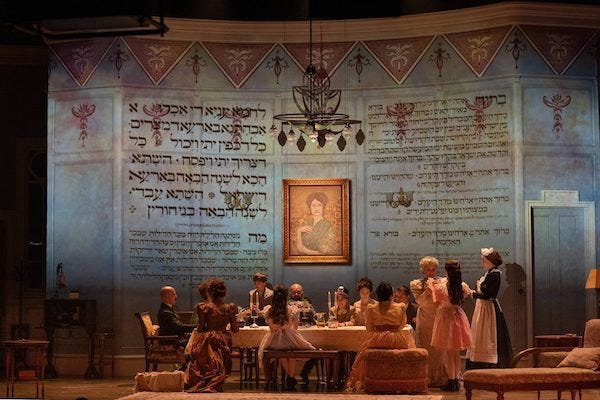
In 2020, with Stoppard now 83, I ordered tickets for Leopoldstadt in London, knowing it might well be his last play. He was finally writing about parts of his own life story. I prepared myself by reading Hermione Lee’s wonderfully researched biography Tom Stoppard: A Life. Covid waylaid the opportunity because the play was closed due to the pandemic. Still, I did see the production in New York on the second night of its run.
Some criticized the script as emotionally cold, but for me, it was fascinating to see Stoppard write autobiographically, relying less on irony and gamesmanship than on feeling. Furthermore, he was tackling his Jewish identity. The play was a success when it was presented at the Huntington Theatre Company a few years ago (Arts Fuse review). In an interview, Stoppard told Christiane Amanpour, “It was somewhat just inward-looking to keep talking about my own charmed life as if I had no history. That, in the end, I have to say, is why the play was written. Everything upfront. I was just giving myself a history that I was never quite acknowledging.”
Stoppard’s plays and ideas, their examination of intriguing philosophical and intellectual questions, have accompanied me through five decades, reinvigorating my love for the art of the theater. Lee placed, at the beginning of her biography, a line spoken by Hannah Jarvis in Stoppard’s play Arcadia, and it strikes me as key — not only to Stoppard’s writing, but to his life:
It’s wanting to know that makes us matter. Otherwise, we’re going out the way we came in.