
Megalopolis
A double take on Coppola's Opus


Megalopolis, Francis Ford Coppola’s epic new film, is the culmination of a project that began over forty years ago. After numerous false starts and revisions, this sci-fi moral fable that imagines modern-day New York as New Rome is finally in theaters. With America closer than ever to imploding, parallels between the fall of Rome and America in the 21st Century are clear. Written, produced, directed, and financed with Coppola’s own money, Megalopolis is a pastiche, an explosion of styles, driven by scenes that careen from surrealistic to expressionistic on theatrical sets, in city streets, nightclubs, and atop CGI skyscrapers. It is built like a meandering Greek tragedy, with political intrigue, power struggles and family duplicity.
Based on, or at least named from, actual characters who lived in 63 BC, it begins in New Rome, which is essentially New York. Cesar Catalina is tilted precipitously on the ledge of his penthouse gazing over the city. Adam Driver is Catalina, a visionary architect who also has the power to freeze time. He has invented a material called Megalon, with which he plans to build a sustainable organic Utopia, Megalopolis. Giancarlo Esposito plays Mayor Franklyn Cicero, with whom he battles for control of the city. Cicero’s daughter Julia, played by Nathalie Emmanuel, drifts into a relationship with Catalina, much to her father’s disapproval. Cesar’s first mistress is a TV commentator named Wow Platinum, played by Aubrey Plaza. Cesar’s fascistic and decadent cousin, Clodio Pulcher, is Shia LaBeouf. He is smitten with Julia, but she will end up in the hands of Cesar’s ultra-rich uncle, Hamilton Crassus III, played by Jon Voight. Others of this motley Dramatis Personae include Kathryn Hunter (Poor Things) as Crassus’ wife, Talia Shire as Cesar’s mother, Jason Schwartzman as Cicero’s right-hand man and Dustin Hoffman as his fixer. Grace VanderWaal, who at age 12 won on America’s Got Talent, does a turn as Vesta Sweetwater, a singer who entertains at one of the Bread and Circus festivities where the rich donate to “help support her pledge” of virginity. Finally, there is Lawrence Fishburne as Cicero’s driver, who, in numerous asides, narrates parts of the film in short speeches, sprinkled with wise maxims.
In a discussion before the premier screening, Coppola talked about how, by financing the film himself, he would have time to rehearse actors with theater games and improvisations to help find the core of each character. He was unclear whether that was part of this film’s production. If it was, it doesn’t show. With all the visual extravagance, the characters feel static and emblematic, representing ideas rather than living, breathing beings. An emotional arc would have helped the audience invest their hearts and minds. Stunning as the film is, actors are reduced to awkward line readings. The lack of emotional substance, aside from gratuitous romance and rhetorical bluster is odd, given that his best films are framed around iconic characters like Michael Corleone in The Godfather, Harry Caul in The Conversation, or William Kilgore and Colonel Kurtz in Apocalypse Now. Here, dialogue is stiff with affirmations, quotes from other plays, and philosophy reduced to aphorisms.
Part of Coppola’s vision was to cast actors of different temperaments in building an ensemble. Several, he said, were “canceled” performers. Shia LaBeouf, with his history of bad behavior, and Jon Voight, a staunch MAGA supporter, come to mind. The idea was to create a diverse group of actors who could work together toward a singular vision, duplicating the utopian society he envisions for the film. The synchronicity of process and content is a Coppola formulation and one that informed The Godfather, which transcended the chaos of its production, well documented in books like Leave the Gun, Take the Cannoli: The Epic Sory of the Making of the Godfather. Apocalypse Now is the clearest example of turning chaos and uncertainty into a vision: the hallucinatory chaos of the Vietnam War. The recently published book, The Path to Paradise: A Francis Ford Coppola Story describes how he turned near madness into the first classic film about that war. It also goes a long way toward understanding the director’s risk-taking genius.
Megalopolis is the director’s opus, a vision that will take time to fully understand. Following a career that experimented with many genres, created masterpieces and delivered numerous skillful features, Coppola sees this as defining his personal style and final vision. It comes at a time far different from when he dreamt up the project. America is a more dangerous place, led by uncertain leaders. People are distrustful and disillusioned.
In his pre-film discussion, he reiterated the themes of the film. He sees the human race not as a collection of assorted beings but as one family. We are endlessly resourceful, he declared and by working together, we can transcend our differences and find real solutions. That is essential, if for no other reason than for the sake of ‘our children’. After 138 minutes of pedantry and visual bravado, that message does, as a friend once said, make crystal clear that which is already painfully obvious.
Coppola is one of our visionary artists, a genius who works with high ideals and thrives on risk. My assessment does not dismiss this remarkable-looking film, which should be seen on a big screen or in an IMAX for people to judge for themselves. As the story leaped from scene to scene with motivations unexamined and questions unanswered, I wondered if future critics of Megalopolis would see it as a misunderstood masterpiece, which happened with Apocalypse Now.
After viewing it, I imagined what that future assessment might be. First is Coppola’s dizzying diversity of visual styles. The assembly of disparate pop elements was part of Stanley Kubrick's approach to Clockwork Orange. With its blend of outrageous costumes, fast and slow motion, theatricality, classical and synthesized music and violence, Kubrick created the first postmodern film. British critics dismissed it for simply promoting violence. According to David Hughes in The Complete Kubrick, his wife Christine said, “Stanley was very insulted by the reaction and hurt”. He withdrew the film from circulation in England in 1978. Kubrick’s film was also emotionally powerful, not merely a visual pastiche.
Unlike Kubrick, Coppola's Megalopolis is a layering of past and contemporary cultural references, borrowing and referencing from the history of film and literature. There are obvious classical Greek references and contemporary nods to Rand’s The Fountainhead and to Orwell’s 1984. Cesar’s first speech in this film is Hamlet’s “to be or not to be” soliloquy. Rambling threads force our attention with quotes and slogans, narration, philosophy, and pseudo-history. Visuals alternate between stagey theatrical scenes and AI-driven film spectacle. Perhaps he is purposefully making some of the actors ridiculous. Some of Voight’s appearances are brief and idiotic. LaBeouf inexplicably spends a good part of the film in a dress. Dustin Hoffman pops in and out like a Jack in the Box. The Bread and Circus nightclubs recall the excesses of Damien Chazelle’s Babylon. The surrealistic visual excess of Canadian filmmaker Guy Maddin came to mind several times. There is a Brechtian element where artifice is critical to delivering a polemic, detached from emotional content, but Coppola’s film is far more abstract than that.
The night following the Megalopolis screening, I saw Fellini’s 81/2 and couldn’t help but see parallels. In that film, Guido (Marcello Mastroianni) struggles to find the idea for his next great movie, for which he has already constructed a huge set. While that is a film about filmmaking (with Mastroianni standing in for Fellini), Coppola’s epic is about filmmaking but much more. Amidst its mad blend of elements is a statement about how art and artists can, like the visionary architect Cesar Catalina, be saviors of the world. Adding Nietzsche to the mix, he could be telling us that we are all artists, all gods, in a way. If we work together to make sense of the world’s chaos, then perhaps we, too, can create a utopia.
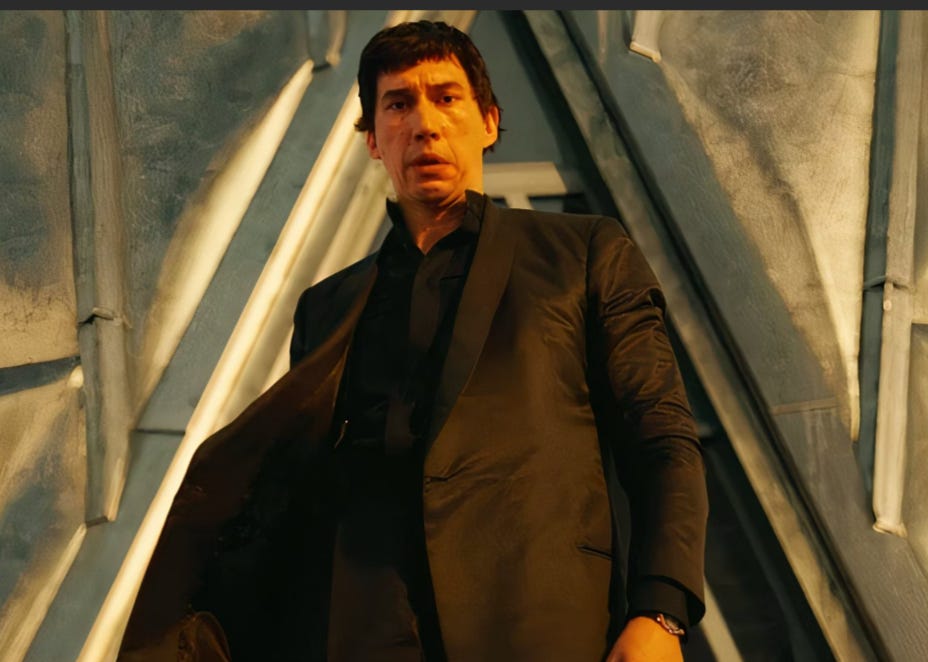
Adam Driver as Cesar Catalina

Giancarlo Esposito is Cicero (he’ll always be Buggin' Out to me)
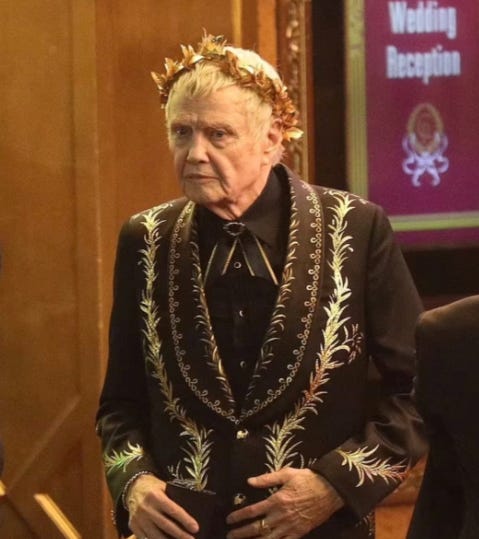
From liberal to MAGA Jon Voight is Hamilton Crassus III
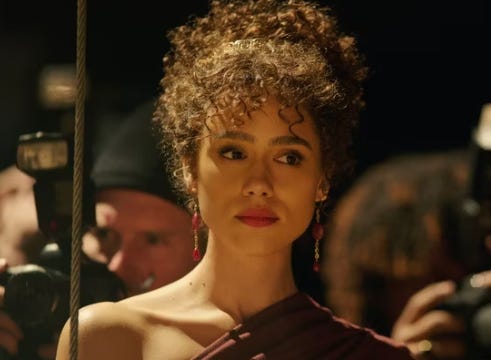
Nathalie Emmanuel as Julia Cicero
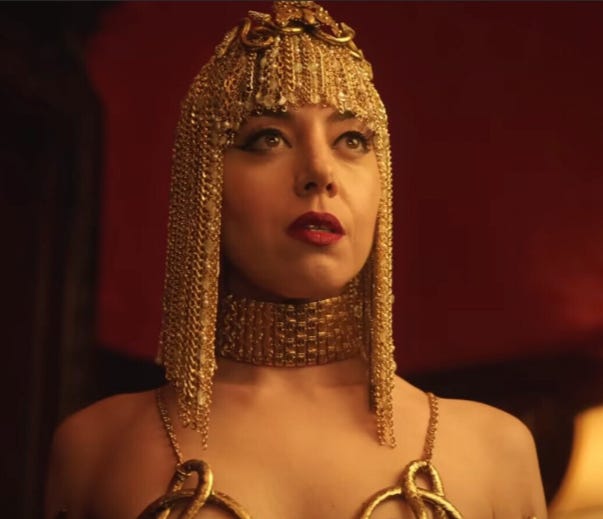
Aubrey Plaza is Wow Platinum
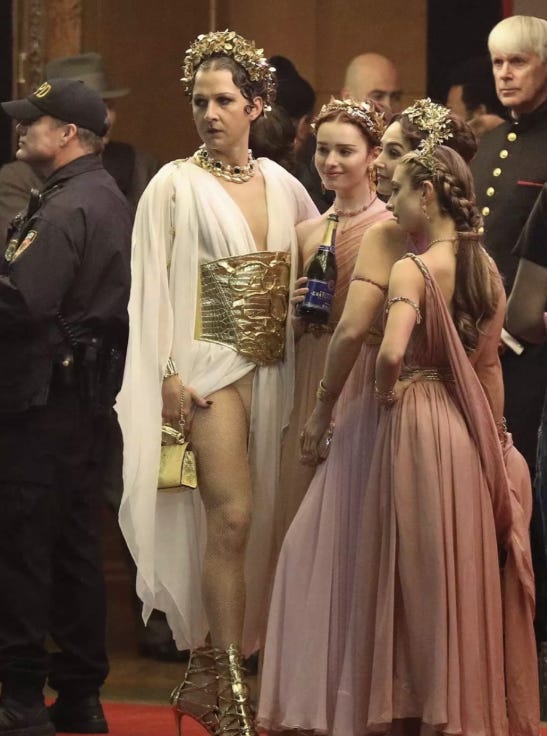
Shia LaBeouf is Clodio Pulcher
Helpful review, Tim. I was dubious about it when I first read about it, and am doubly dubious now.